
Amongst all commercial professional courses, CMA certification signifies the knowledge in areas of financial planning, analysis, control, decision making and professional ethics. If we talk about these core skills in real time business, we must say this are the pillars of any business unit running today. In brief, CMA aspirants should understand the sensitivity of this certification.
Looking into the current market trends and growth of digital technologies, Mohit Agarwal classes thinks that CMA certification could be more simplified by providing online lectures to students. Our expert team of faculty members designed the lectures in methodical way, which is comprehensive enough to understand the core concepts.
We are encouraging students to select CMA inter online classes over traditional classes because of its predominant benefits listed below:
- Flexibility: Online lectures provide benefit to learn in home at own comfort and schedule. Learn at your own pace, however we recommend sincerity, dedication and discipline as required pre-requisites for getting advantage from online classes.
- Portable: While designing CMA online course, we have considered all the trouble points to simplify the things like for students who are in remote area and internet connectivity is still an issue for them then they can select our CMA inter pendrive classes. We have bifurcated the courses for the aspirants accordingly like CMA final pendrive classes.
- Cost effective: when preparing through online or electronic medium one not only save commute time but the regular fares, which saves some money for students and many chore expenses.
At Mohit Agarwal classes we are continuously improving our resources in order to answer student’s query quickly, Moreover students who are enrolled for online CMA video lectures or CMA pendrive classes say that teachers are very energetic and passionate towards knowledge sharing which inspires them to complete the syllabus on time.
The CMA exam is bifurcated into two parts that you apply for and can appear separately in any order. First Part covers financial reporting, planning, performance, and control. Second part covers financial decision-making. For each part we have covered all the core concepts in exhaustive way, so that one can sit in couch and prepare well.

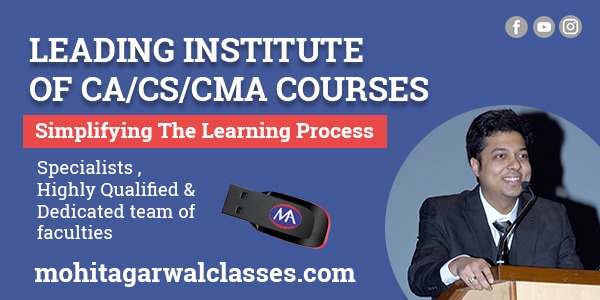
 Mohit Agarwal Classes